
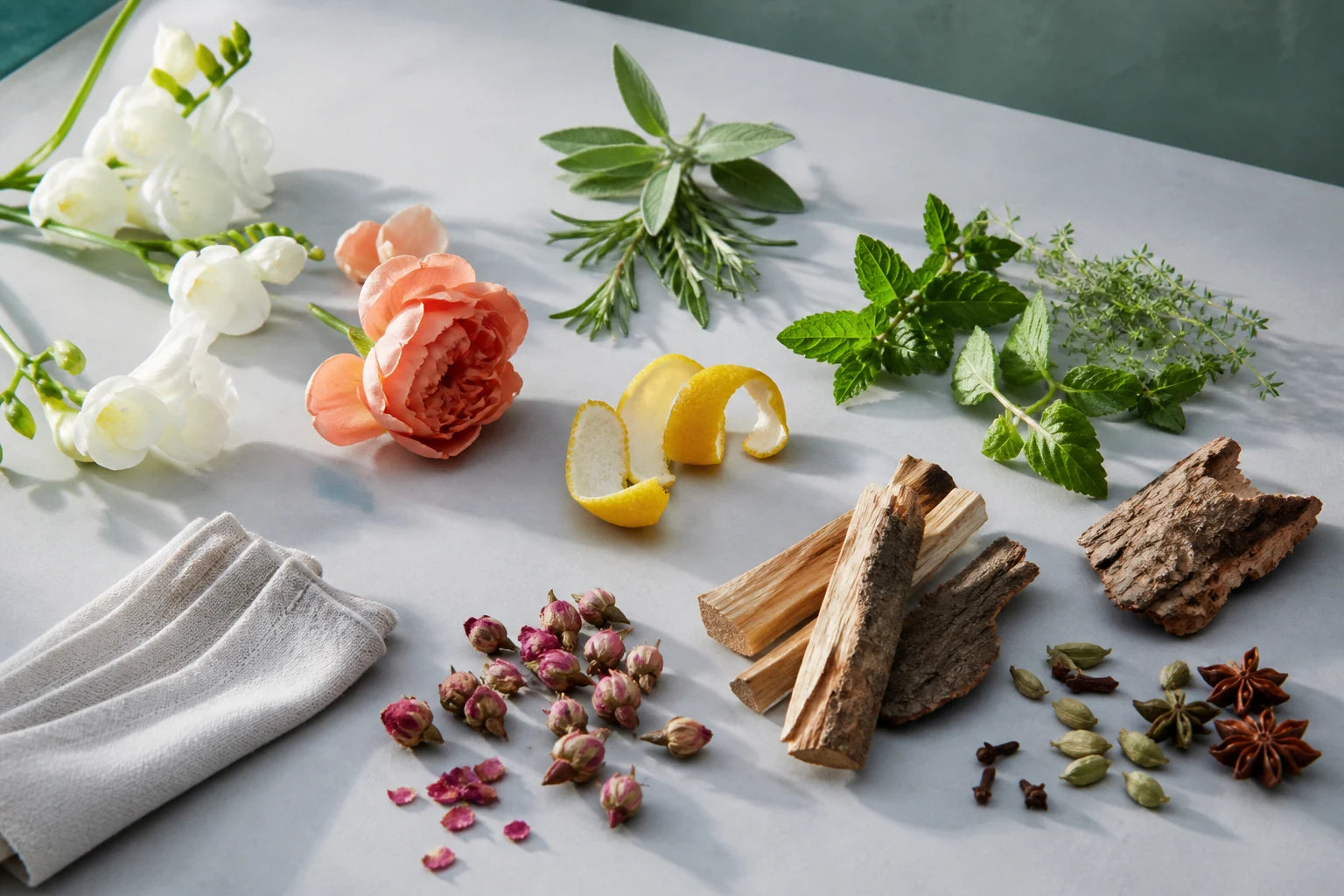
Scent families are a practical vocabulary for comparing fragrance descriptions. Floral, woody, fresh, warm, citrus, herbal, and musky can help you say what you recognize and prefer. They are not a complete ingredient list, a safety statement, or a universal system that every brand uses in exactly the same way.
The International Fragrance Association describes fragrance ingredients as materials used for odor properties or malodor coverage and maintains a transparency list of materials used across fragrance mixtures. A product's customer-facing notes are still a description of how the fragrance is presented, not proof that the pictured flower, fruit, wood, or textile is physically present in the formula.
Use scent-family words to compare confirmed descriptions. Do not treat scent notes as ingredient, formula, direction, or safety proof.
Floral
Floral descriptions point toward flowers or flower-like impressions. Common words include rose, iris, jasmine, violet, orange blossom, and peony.
A floral scent may be sheer, green, powdery, watery, creamy, or rich. “Floral” alone does not tell you whether a candle will feel light or strong, modern or traditional. Look at the other notes and the way the product describes the overall direction.
Floral also does not mean “for women.” Scent preference is not a gender category.
Woody
Woody descriptions reference materials or impressions such as cedar, sandalwood, vetiver, cypress, dry timber, bark, or forest floor.
Some woody profiles feel dry and architectural; others are creamy, smoky, green, or earthy. A woody note can support a floral, citrus, warm, or musky composition rather than defining the whole fragrance.
Do not assume “woody” means heavy, masculine, or strong. Read the complete profile.
Fresh
Fresh is a broad description rather than one precise ingredient family. It may point toward airy, watery, green, crisp, mineral, clean, or lightly citrus impressions.
Because “fresh” can mean many things, look for the words around it. Fresh-cut stems, sea air, white tea, and citrus peel create different expectations.
Fresh does not prove that a candle cleans the air. It describes an odor impression, not a purification function.
Warm
Warm descriptions often bring together spice, soft woods, amber-like impressions, vanilla-like sweetness, toasted notes, honeyed facets, or creamy textures.
Warmth is a sensory metaphor. It does not mean the fragrance changes body temperature or guarantees comfort. Ask whether you enjoy sweet, spicy, resinous, creamy, or dry warmth, because those directions can feel very different.
Citrus
Citrus descriptions may reference grapefruit, bergamot, lemon, mandarin, orange peel, or related bright and tart impressions.
Citrus can appear alone, with herbs, with tea, or above a woody base. It is often described as bright or sparkling, but those words do not prove an energizing effect.
A note name is also not an ingredient declaration. Verify the product record when ingredient information matters.
Herbal
Herbal descriptions can include rosemary, basil, sage, lavender, mint, thyme, or other green aromatic impressions.
Some herbal profiles feel leafy and sharp; others feel soft, dry, or tea-like. Lavender can appear floral, herbal, or both depending on the surrounding description.
Avoid turning herb names into health claims. A fragrance description does not establish therapeutic use.
Musky
Musky descriptions often refer to soft, skin-close, clean, warm, powdery, or textile-like impressions. The term can describe an effect in the composition rather than one material a customer could identify visually.
“Musky” does not automatically mean strong, animalic, sensual, or body-use. Read how the product pairs it with floral, woody, warm, or fresh notes.
A candle can belong to more than one family
Most fragrance descriptions combine directions. A candle might be floral-woody, citrus-herbal, warm-musky, or fresh-woody. The useful question is which family leads and what supports it.
Try this three-part reading method:
- Lead direction: What do you expect to notice first in the description?
- Supporting direction: What adds contrast, depth, softness, or brightness?
- Familiar reference: Which listed notes have you smelled and liked before?
This method helps you compare language without pretending to reconstruct the formula.
Scent notes are not ingredients
A product may describe rose, cedar, grapefruit, or cashmere-like softness. That does not by itself establish that rose oil, cedarwood oil, grapefruit oil, or a material called cashmere appears in the formula.
For scent preference, use confirmed identities and description directions as sensory guidance. This article does not establish ingredient, formula, direction, or safety facts.
Scent family is not scent strength
Floral is not automatically subtle. Woody is not automatically strong. Citrus is not automatically fleeting, and musky is not automatically close to the skin.
Strength or fragrance presence needs product-specific evidence or preference language. Read How to Choose Candle Scent Strength Without Guessing for that separate decision.
Connect family to Mood without collapsing them
EVODUCK Moods help you choose a sensory direction. Scent families help you read the fragrance description. One does not replace the other.
For example, a warm direction may support HOLD, while a clear citrus or tea direction may support RISE. But the actual profile must be confirmed on the product page. Do not assume notes from the Mood name alone.
Use How to Choose Fragrance by Mood to combine the two steps.
Frequently asked questions
What are the main candle scent families?
This guide uses floral, woody, fresh, warm, citrus, herbal, and musky as practical shopping vocabulary. Other systems may group or name them differently.
Is vanilla a warm scent?
Vanilla-like descriptions often appear in warm or gourmand directions, but the surrounding notes and full product description matter.
Does a rose note mean the candle contains rose oil?
Not necessarily. A scent note describes the presented odor impression; it is not an ingredient or formula declaration.
Which scent family is strongest?
No family has a universal strength ranking. Strength is product-specific and preference-dependent.
Build a vocabulary before choosing
Explore the Mood Hub, browse Scented Candles, or compare Floral vs. Woody Candle Scents with this vocabulary in hand.